Brush clearing removes dense overgrowth and reduces wildfire fuel loads across Texas properties. Redhawk Land Services provides strategic brush removal and fire break installation for homeowners, ranchers, and rural landowners throughout the Houston area — protecting structures, improving access, and making land easier to manage year-round.
Texas wildfires don’t give much warning. When dry conditions hit and wind picks up, thick brush becomes a direct threat to structures, fences, livestock, and lives. Proactive brush management is one of the most practical investments a rural property owner can make — and it pays dividends in safety, usability, and peace of mind every season.
Brush clearing is the systematic removal of dense undergrowth, overgrown vegetation, scrub trees, and accumulated dead material from a property. In Texas, the most problematic species tend to be fast-spreading, fire-adapted plants like Yaupon holly, Cedar, Mesquite, and Greenbrier — vegetation that spreads aggressively and creates the kind of continuous fuel load that allows fires to move quickly across a landscape.
What’s the difference between brush clearing and land clearing? Brush clearing focuses on removing undergrowth and problematic vegetation without necessarily clearing every tree on the property. It’s a more targeted approach suited to properties where some existing vegetation is desirable and only the overgrowth or hazardous material needs to go. Full land clearing, by comparison, removes most or all vegetation from a site.
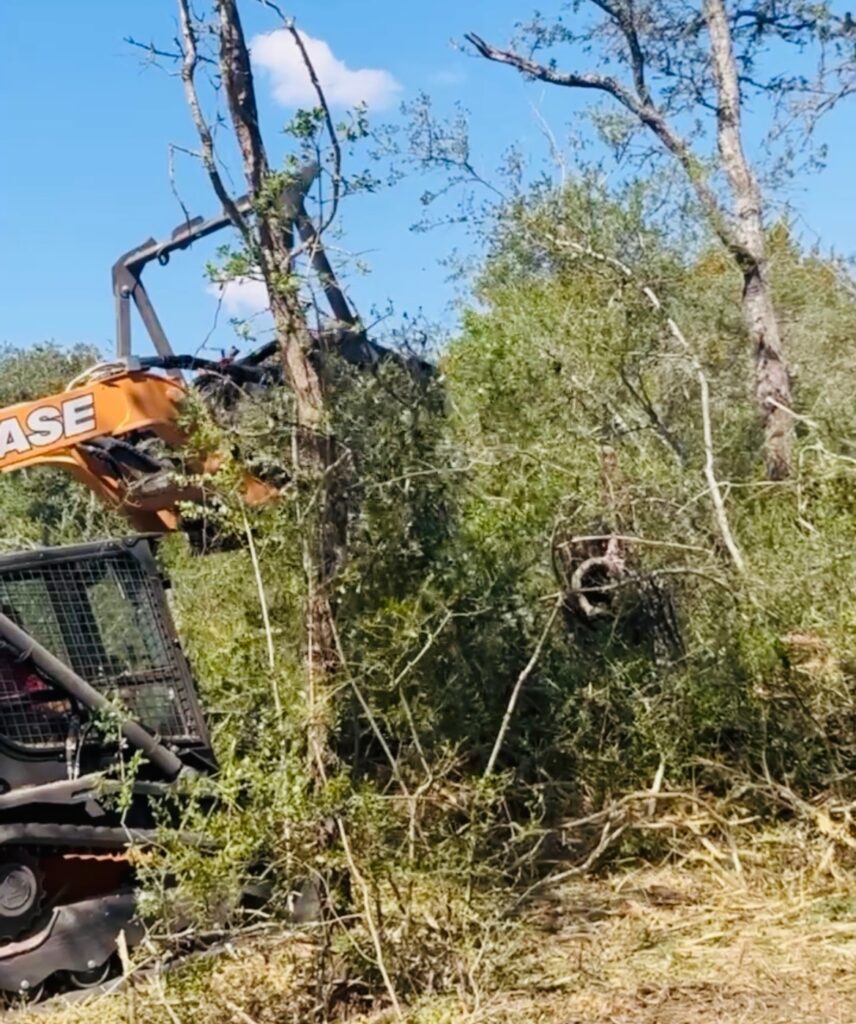
Property owners sometimes put off brush management because it feels optional. It rarely is — especially here in Southeast Texas. The costs of ignoring it tend to compound over time.
Dense brush along fence lines damages and destabilizes fencing over years, costing more to repair than proactive clearing would have. Overgrown access paths and roads become difficult or impossible to navigate with equipment, creating delays during emergencies or routine maintenance. Properties with heavy brush accumulation are significantly harder to sell, insure, and manage.
And then there’s fire. According to Texas A&M Forest Service data, thousands of acres burn across Southeast Texas each year, with the majority of structural losses occurring on properties with heavy brush surrounding buildings and access routes. Fire breaks — cleared zones that slow or interrupt fire spread — are one of the most effective ways to protect what’s on your land.

Redhawk’s brush clearing work is strategic — not just a matter of clearing everything in sight. The goal is to target the growth that creates risk and maintenance problems while leaving the natural features that add value to the land.
The areas that benefit most from brush clearing are around structures (homes, barns, equipment storage), along fence lines and property boundaries, adjacent to access roads and driveways, and in areas where overgrowth creates visibility or safety concerns. Redhawk typically starts with these zones and works outward based on your priorities and budget.
A fire break is a cleared corridor — typically running along a property boundary or between a structure and adjacent heavy vegetation — that’s designed to interrupt or slow fire spread. The width, placement, and vegetation management within the break all affect how well it performs. Redhawk designs fire breaks based on the terrain, wind patterns, and vegetation density specific to your property.
Depending on the density of the brush and the desired outcome, Redhawk uses forestry mulching equipment, brush cutters, or a combination of both. Forestry mulching is often the best fit for areas with heavier brush and tree growth, since it grinds material in place rather than leaving piles that then need to be burned or hauled. For lighter maintenance clearing, brush cutting is fast and efficient.
Brush clearing rarely happens in isolation on a working property. Redhawk commonly combines it with other services for a complete approach to land improvement.
Properties with heavy brush often also have compromised fence lines, so fence line clearing is a natural pairing. If the brush has been encroaching on what was once productive pasture, pasture reclamation work may be the logical next step after the initial clearing is done. And when you want to preserve mature trees while removing the undergrowth around them, selective land clearing gives you the precision to do that without losing canopy you want to keep.
The free site visit Redhawk offers is where all of this gets sorted out. You’ll walk the property together, talk through your goals, and come away with a clear plan — not a guess.
This service is a fit for a wide range of Southeast Texas property owners. Rural homeowners on large lots who want defensible space around their homes and improved aesthetics. Ranch and farm operators who need passable access roads and reduced fire risk across large acreage. Property owners preparing land for sale, lease, or development who need to clean up years of accumulated overgrowth.
If your land has become harder to manage, less usable, or more dangerous because of brush accumulation, contact Redhawk for a free estimate. We serve Houston and surrounding areas including Huntsville, Bastrop, Rosenberg, and Lake Jackson.
Fire break width depends on terrain, local wind patterns, and the density of adjacent vegetation. A general recommendation for residential properties is a minimum of 30 feet between structures and heavy brush. For ranch land with high fuel loads, wider breaks of 50–100 feet provide more meaningful protection. Redhawk assesses your specific site and recommends appropriate dimensions.
In Southeast Texas, fast-growing brush species can reclaim cleared areas within 2–3 years without maintenance. An annual or biennial inspection — with targeted clearing of any regrowth — is usually sufficient to keep fire breaks effective and access routes clear.
Yes. Redhawk’s equipment operators are experienced working in tight corridors along fence lines and around buildings. The goal is always to clear what needs clearing without damaging the infrastructure that’s already in place.
Mechanical brush clearing on private property generally does not require a permit in most Texas counties. Open burning, however, does require a burn permit in many areas and is subject to local burn bans. Redhawk’s mulching approach eliminates the need for burning entirely.
Late fall through early spring is ideal — vegetation is slower-growing, conditions are cooler for equipment operators, and clearing is completed before peak fire season. That said, Redhawk performs brush clearing year-round based on client scheduling needs.
Reducing fire risk starts with proactive brush management. Contact Redhawk Land Services LLC to develop a fire break mitigation plan for your property.
